• Combat sports is an umbrella term referring to any sport based around physical violence, either practically or traditionally. While not every sport practiced at the Games is a practical matter of self-defence, many of them are used today by law enforcement, the military, and private citizens.

    History
    The human race has been fighting for as long as we have existed, and several sports featured in the Olympic Games have rich cultural histories dating back to ancient times. Of course, there is no “victory or death” mantra any longer, and athletes would hardly be expected to break their own necks rather than lose a fight. They also wear protective gear and abide by tournament regulations, which ensures a safe experience for the competitors.

    All combat sports are separated into weight classes among competitors. The definitions may vary slightly from sport to sport, but every one has a series of weight classes to ensure fair fights.

    Wrestling (freestyle & Greco-Roman)
    Wrestling is broadly divided into two major categories. Greco-Roman wrestling emulates the ancient techniques practiced since 708 B.C., and combatants may only use their arms and upper bodies to attack their opponents’ arms and upper bodies. The rules for what constitues a pin are also slightly different from freestyle wrestling, which allows leg holds and various other pinning possibilities.

    Victory is awarded if one wrestler pins his opponent, but in the event of a standstill judges will decide the victor based on technique and time spent in advantageous positions.

    Boxing
    Boxing is a sport known for its simplicity, and Olympic boxing is no exception. Two boxers, fists only, above the belt. After a specific number of rounds, the judges rule if there has not been a knockout or forefeit.

    Boxing is a sport focused on mobility (“floating” by hopping on the tips of one’s toes and making movement unpredictable) and a handful of punch techniques. The jab, straight, hook, and uppercut are the four foundational punches of any good boxer.

    Fencing
    Combat using body armour and specialized swords. Olympic fencing is entirely point-based, with points awarded based on the hit’s type and location. There are three types of swords:
    – Foils: very light swords used for thrusting; fencers may only strike the torso and double touches are not allowed
    – Épées: a heavier thrusting sword; fencers may strike any body part and double touches are allowed
    – Sabres: a sword which can both cut and slash; fencers may strike anything above the waist except for the back of the head and hands, and double touches are not allowed

    Above all else, fencing is a precision sport. Small mistakes in movement or space control can mean the difference between scoring a point and being defeated with the flick of the opponent’s wrist.

    Judo
    Judo is a Japanese martial art focused on throws and takedowns. Competitors are awarded points based on the type of takedown used, with more commanding takedowns being worth more points. The difference in score can be quite severe: the first man to score a single point (Ippon) or two half-points (Waza-ari) wins the match. “Almost half-points” (Yuko) are tracked, but are only relevant if the match results in a tie. A point is awarded by knocking down the opponent and maintaining a positional advantage.

    Karate
    Karate is a strike-based Japanese martial art debuting at the 2020 Tokyo Olympics. It will feature a traditional kumite competition as well as a kata (form) competition, and be open to both men and women.

    Taekwondo
    A Korean martial art that incoporates the entire body, but which is most famous for its focus on kicks. Taekwondo disciples often use spinning and jumping kicks that would be considered impractical in other forms of martial arts. It has been an Olympic sport since 1988 when the Games took place in Seoul, South Korea (as a demonstration sport) and an official sport since 2000 in Sydney, Australia.

    Because Taekwondo is a striking martial art (compared to judo, which focuses on throws), scoring is much more granular. Kicks are permitted to target the entire upper body, and punches may target the torso. Competitors are tracked electronically, and their pads use electronic sensors to ensure strikes are delivered with sufficient force.
    – Body punches score one point.
    – Body kicks score one point, but can be worth three if the attacker uses a spinning technique.
    – Head kicks are always worth three points, but a spinning technique will add an additional point. Head kicks always score, regardless of the force used.
    – Knocking down an opponent will always result in one point, even if the attacker used a kick.

    Fighters may not remain inactive, and the fight is automatically ended if one fighter accumulates a 12-point lead on his opponent. In the event of a tie, competitors enter sudden death where the next figher to score is the victor.

  • Aquatics include individual and team disciplines such as diving, swimming, synchronized swimming, and water polo, as well as equipment-based sports such as rowing, sailing, surfing, and canoe/kayaking.

    History
    Aquatics is among the oldest field at the modern Olympic Games, although none trace their lineage back to the ancient Greeks. Swimming has been a part of human life as long as men have lived near water, but the Games take a more artistic approach to the sport. Competitors are often judged on skill and speed, and given freedom to move about the water as they choose – this is different from some other Olympic sports (such as the winter sport biathlon, or combat sports) which mimic traditional activities like hunting or warfare and have strict rules.

    Sports

    Diving
    Diving was first introduced in the 1904 St. Louis games and has never been removed from the program, although it has changed considerably. Initial dives were called “fancy diving” when referring to the various somersaults and twists performed by divers, which was distinct from the Plunge for Distance event. The latter was removed in the subsequent Games and replaced with springboarding. Additional events and womens events were added in the following decades.

    Modern Olympic diving has several categories, with divers leaping from various heights. In each category, the goal is to score as many points as possible by performing tricks and acrobatics before hitting the water. When entering the water, the size of a diver’s splash is also part of his score: the smaller, the better.

    Swimming & Marathon swimming
    Dating back to the very first modern Olympic Games in 1896, swimming is one of the most consistently well-attended events at any Games. Swimming is a very simple sport, stripped of any of the artistry of diving: it’s a simple race across a set distance, which is defined by lengths of the pool. Each swimmer gets a lane separated by buoys, and time is measured from a starting gun to the instant the swimmer touches the finishing wall. Events include freestyle swimming, which is often dominated by the front crawl or butterfly strokes, and specific categories which only permit one type of stroke, or a combination of strokes. Distances range from 50m to 800m.

    Marathon swimming is the same as regular swimming, but the race takes place over a distance of 10km instead.

    Synchronized swimming
    Now known as artistic swimming, this is the act of a duet or troupe of swimmers performing a water dance within a set amount of time. Previous Games included a solo event, but this has been discontinued since 1996. Notably, synchronized swimming is a women-only sport.

    Water polo
    Mens water polo has been part of the Games since 1900, but there was not a womens event until a century later in 2000. Water polo is a competitive ball sport played in a pool using a net. Each team fields six players and a goalkeeper. It is similar to basketball and soccer: players must control the ball and attempt shots on the opposing goal to score points. The team with the most points at the end of the game is the victor.

    Canoe/kayak (sprint & slalom)
    Canoeing and kayaking are race events that take place either in straight lanes similar to a swimming race (sprint) or more technically demanding competitions that require navigating a simulated whitewater river. The distinction between these events is the type of vessel used and the number of rowers. A C-2 race means canoes with two rowers, whereas a K-1 race means kayaks with single rowers. Canoes have 1-2 rowers, whereas kayaks have 1, 2, or 4. The distance of a race can range from

    Rowing
    A waterborne race between multiple vessels, each of which is powered by a team of rowers. There are a variety of distances and event types, which are offered to men and women. The categories include single, double, and quadruple sculls, and coxless pairs and fours. Sculls are rowing boats where each rower grasps an oar in each hand, and coxless boats are boats with lopsided oars, with each rower using both his hands to grasp one. There is also no “coxswain,” or boat captain, to direct the rowers in coxless categories.

    Sailing
    Referred to as yachting until the 2000 Games, sailing has been at almost every single Games since 1896. Its scoring systems and race format have changed dramatically over the years, with many revisions to scoring and accounting for ties, and some Games have fleet races (open races with many boats) and others using a match race format (two individual boats competing head to head). There has also been change in the way boating classes are calculated (length vs weight).

    Sailing was initially a unisex sport, and women competed in the early 20th century, with the single exception being the 1948 Games. For a complete listing of the many type of boats used over the years, consult this link.

    Surfing
    Surfing will make its debut appearance at the 2020 Tokyo Olympics. The event itself will take place in the ocean near Chiba, not a wave pool, and will use a four-man heat structure, with the top two in each heat advancing.

  • This page is a header for the various leagues of professional sports covered on WatchingAllSports.com. Please use the menu at the top of the page to select a specific sport.

  • This post is a header which contains all the Olympic sports covered on WatchingAllSports.com. Please use the menu at the top of the page to select a specific sport or category.

    Olympic Sports
    [placeholder for an explanation of the olympics and their different sports]

    Summer Sports
    Water sports
    – Diving
    – Swimming & Marathon swimming
    – Synchronized swimming
    – Water polo
    – Canoe/kayak (spring & slalom)
    – Rowing
    – Sailing
    – Surfing

    Combat sports
    – Wrestling (freestyle & Greco-Roman)
    – Boxing
    – Fencing
    – Judo
    – Karate
    – Taekwondo

    Gymnastics
    – Artistic
    – Rhythmic
    – Trampoline

    Track and field
    – Athletics

    Other athletics
    – Skateboarding
    – Sport climbing
    – Pentathlon
    – Triathlon
    – Weightlifting

    Cycling
    – BMX freestyle & racing
    – Mountain biking
    – Road cycling
    – Track cycling

    Equestrian
    – Dressage
    – Eventing
    – Jumping

    Marksmanship
    – Archery
    – Shooting

    Traditional sports (teams & singles)
    – Basketball (and 3-on-3 basketball)
    – Volleyball (beach & indoor)
    – Badminton
    – Baseball
    – Softball
    – Field hockey
    – Soccer
    – Golf
    – Handball
    – Rugby sevens
    – Table tennis
    – Tennis

    Winter Sports

    Skating
    – Figure skating
    – Speed skating (long and short track)

    Skiing & Snowboarding
    – Cross-country skiing
    – Alpine skiing
    – Ski jumping
    – Nordic combined
    – Freestyle skiing
    – Snowboarding
    – Biathlon

    Sledding
    – Luge
    – Bobsleigh
    – Skeleton

    Ice sports
    – Ice hockey
    – Curling

  • This page is a header for the various professional sports covered on WatchingAllSports. Please use the menu at the top of the page to select a specific sport.

    The difference between professional sports and Olympic sports has slimmed as more and more athletes have accepted more and more endorsements from corporations. Furthermore, one of the Olympics’ founding principles – that competitors should be gentleman amateurs, who played sports enthusiastically but casually – is no longer a popular idea. Thus, the idea that the Olympics should restrict themselves to only allow amateur athletes (who are invariably at a disadvantage compared to their specialized counterparts) was no longer valid.

    Of course, allowing professional athletes to compete also means allowing professional sponsors to advertise, which is another compelling factor. You can read a bit further at this link.

  • The Winter Olympic Games are held every four years, alternating with the Summer Olympic Games, although this was not always the case. Until 1992, the Games as a whole were only held every four years, and both Games would be held in the same year. Starting with the 1994 Winter Games in Lillehammer, Norway, the Winter Games began alternating with the Summer Games.

    To see individual sports for the Winter Games, please use the menu at the top of the website.

  • The Summer Olympic Games are held every four years, alternating with the Winter Olympic Games. To see individual sports for the Summer Games, please use the menu at the top of the website.

  • Olympic Skiing & Snowboarding

    Professional and Olympic skiing have many of the same roots and techniques, but the focus of the Olympic events is narrower than dedicated skiing events such as the FIS Alpine Ski World Cup. These dedicated events allow athletes to focus on much more technical parts of skiing (such as telemark skiing, which combines several events including a jump and a slalom, and which uses specialized skis attached only at the front). These differences, though valid for enthusiasts, would likely not be noticed by the Olympics’ much broader audience.

    Olympic skiing is more reserved, because it focuses on the skill of the athlete rather than his marketability. There are several forms of olympic skiing, and although we will not list all of them, there are some broader categories that divide the sport.

    Snowboarding has also been included in this section, because it uses many of the same techniques as skiing and takes place on similar terrain.

    Slalom
    Skiiers race on a winding downhill track, and must keep on the outside of flags which the track is formed around (the olympic colours are typically red and yellow). Notably, the rules are only concerned with the skiiers’ actual skis, so athletes will frequently whip their torsos into the flags to hug corners as tightly as possible.

    Ski jumping
    One of the few ski events that does not use poles, ski jumping is the practice of using an enormous ramp positioned on the side of a hill to fly as far forward as possible. Skiiers competing in this sport often position their skis in a V shape and twist their ankles upward as much as possible to glide better. Professionals can remain airborne for very long periods of time depending on the size of the ramp and the track leading to it.

    Trick skiing
    Similar to a slalom, but instead of competing for time, skiiers ski a track with two or three opportunities to perform tricks, which are graded by judges. At the olympic level, skiiers are often given a second attempt to average their scores and prevent outlier performances.

    There are several different types of trick skiing, such as the halfpipe, or mixed tracks that feature rails and small ramps. The exact specifications vary from each Games to the next.

    Cross-country skiing
    A form of skiing that prioritizes endurance and consistency over alpine skiing’s blazing pace. Skiiers ski on flat round compared to alpine slopes, and races lengths are often multiple kilometres. The challenge comes from consistently pacing oneself rather than the barely controlled accident that is an alpine skiing run.

    Biathlon
    A form of cross-country skiing that combines the endurance of that sport with the precision of marksmanship: athletes ski for great distances (while carrying rifles) before making quick stops to fire at targets marked at specific distances. Because the events are timed, skiiers make these shots facedown in the show with their skis and poles still attached.

    Biathlon is an interesting sport because it is one of the most visible remnants of the Olympic Winter Games’s roots as the Nordic Games, which existed around the turn of the 19th century. Few other countries had the right kind of environment for skiing and shooting, but in a Nordic or Scandinavian country, combining the two was often a matter of necessity if you wanted to eat.

    Snowboarding
    Snowboarding has many of the same broad goals as skiing, and many of the same goals (control the board, complete a challenge quickly, perform tricks to gain points from the judges, etc.). The sport first originated in 1965, and originated as a recreational activity in contrast to skiing, which has many practical applications for hunters and rescue personnel.

    The most distinctive feature of snowboarding is as simple as it looks: athletes compete with two feet on a board instead of two skis. This allows them to be more stable than skiiers, and for amateurs to take up the sport with less work on their balance. Aside from the different stance, the sports are quite similar, and their Olympic events are also quite similar: athletes take part in races, trick competitions, and combinations thereof. There is no snowboarding equivalent of biathlon or ski jumping.

    History
    Skiing has been around as long as the Olympic Winter Games have existed. It is a popular and simple sport, which gives it enduring appeal for spectators and organizers alike.

    Differences
    [list any notable differences from the professional sports played the majority of the time]

    Olympians
    [mention any notable athletes who achieved success at the olympic games in this sport]

  • Olympic Skating

    Olympic skating is a broad category, but the majority of events are speed skating and types of figure skating for solo and pairs events of varying lengths. With the beauty of dance and the precision of an icepick, figure skating is a visually dramatic sport – even if it can become too flambuoyant for its own good at times. Speed skating is much simpler, but remains appealing due to the startling speed of its competitors.

    History
    Funnily enough, skating and ice hockey were initially featured in the Olympic Summer Games before the Winter Games were recognized as a separate event. Thus, they are slightly older than other winter olympic sports, dating back to 1908.

    Differences
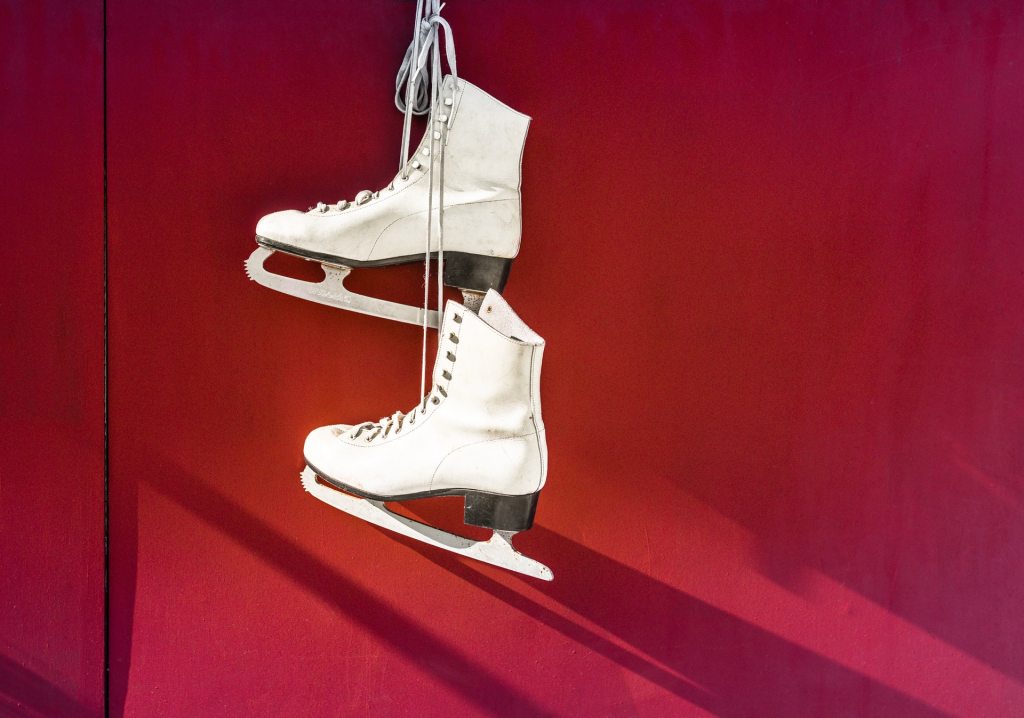
    Figure skating is the act of performing a dance while on skates; notably, figure skates are narrower than hockey or speed skates, and have a spur at the front of the blade to give the skater more control when balancing. There is some overlap with traditional ballet tricks such as pirouettes and spins, but there are many figure skating tricks unique to the sport.

    The official olympic events are men’s singles, women’s singles, pair skating, and ice dance. The singles events are straightforward: the performer has a set amount of time to perform tricks while accompanied by music of his choosing. Pair skating is the same, but with two skaters working together. The ice dance, in addition to being the youngest type of figure skating at the olympics, is effectively ballroom dancing done on ice. This different tradition of performance gives it a much more intimate and condensed feeling compared to pairs skating.

    Speed skating is the polar opposite of figure skating: competitors race around a track, aiming to go as fast as humanly possible on ice. The divisions of the sport resemble different types of track or velodome races, with different categories rangig from 500 metres (practically a sprint) to 5000 metre marathons. There are also relay and team events.

    Speed skaters use specialized skates that have long, flat blades that give the skaters as much grip on the ice as possible without sacrificing velocity. Because speed skaters only ever turn left, the challenge to compete at an Olympic level comes from optimizing every single part of the ovoid track. On corners, this means leaning over the boundary line and practically skating while horizontal, before snapping back up to a wide, powerful stance to gain speed on the straightaways.

    Short track events, especially team events, complicate things further: it’s possible to have eight skaters on the track at a single time, each of whom is jockeying for position at highway speeds of around 45km/h (or about 28mph). Passing on the corners is virtually impossible due to the additional distance traveled, so competitors must time their attacks perfectly or risk losing everything to a crash.

    Olympians
    [mention any notable athletes who achieved success at the olympic games in this sport]

  • Olympic Track and Field

    Track and field are actually part of a larger subsection of “athletics” within the official Olympic documentation, but the layman’s idea of running and throwing things is still the most accurate label. The only difference is that some races take place on roads instead of tracks.

    History
    Running is one of the oldest human activities and can trace its roots all the way back to the ancient Olympics. Field events such as the javelin toss and discus throw are more obviously inspired by the ancient Greeks.

    Differences
    Rather than list each individual medal event, here you will find each category of track and field sports.
    Track
    – Sprinting: running distances under and including 800 metres
    – Marathon: longer distances up to and including 10,000 metres (on a track) or a marathon (on a road)
    – Hurdles / Steeplechase: sprinting and marathon running with obstacles on the track. Hurdles are waist-high, and steeplechase obstacles includes hurdles and jumps over water pits.
    – Relay running: any of the longer distances above (not marathons), run by teams. Each team member runs a different leg of the race.
    – Race walking: a long-distance only category run on roads wherein competitors must remain in contact with the ground at all times (as seen by the human eye). The supporting leg must remain straight until the lifted leg passes it.

    Field
    – High jump: Athletes jump over a horizontal bar without dislodging it; the bar is raised progressively higher in each round of competition. Interestingly, the techniques used to clear higher and higher bars have improved over the years. Initially, athletes had a standing start and used a jackknife jumping form. Later years allowed a running start, and the jumping form changed to a scissor kick, then a straddling method, then a western roll. Consult this video for visual reference. The current method is the Fosbury Flop, named after American athlete Dick Fosbury who pioneered the technique in Mexico City in 1968.

    – Long jump: Athletes get a running start before jumping as far as possible into a pit of sand. In addition to the athleticism required, the scoring system affects jumpers’ techniques. Because the farthest back part of an athlete’s body is used as the measurement point, a proper athlete will land with his legs as far forward as possible, then rock forward to avoid falling on his bottom.

    – Triple jump: Similar to the long jump, but the total distance is derived from a series of three jumps, each of which must be done in a specific manner. Also called the “hop, skip, and jump.” The hop must be launched and landed with a single leg, the skip must launch from the hop leg to the other leg, and the jump must be launched with both feet.

    – Pole vault: Similar to the high jump, except athletes are given a long, flexible pole with which to propel themselves upwards.

    – Shot put: The “shot” is a metal ball, and the “put” refers to competitors propelling it forward from an initial spot near the neck. The ball may only be released once it is above the shoulders. Distance is counted from the closest point of contact with the ground, rather than the ball’s final resting spot. Despite its archaic appearance, this sport does not date back to the original Olympic games. Instead, it more likely developed during the Middle Ages in England and Scotland, when soldiers would have competitions to see who could throw cannonballs farthest.

    – Discus throw: A ancient sport wherein athletes throw a heavy disc called a discus as far as possible. As with the shot put, there are some rules which describe where the athlete may stand, but there are no restrictions on how the discus is thrown. Throwers primarily use a one-and-a-half spin overhand grip because it is most effective at transferring spinning momentum to the discus.

    – Hammer throw: The hammer in this case is a metal ball on the end of a steel wire, rather than an actual hammer. Similarly to the discus throw, competitors spin inside an allotted area before releasing the hammer downfield. Performance is gauged from a series of throws to limit the effects of fouls and outliers.

    – Javelin throw: A javelin is a type of spear, and although the contemporary Olympic model is not used for warfare, it still resembles the ancient Greek weapon it derives its name from. Competitors have a running start before throwing the javelin as downrange as possible. Interestingly, the ancient Greeks actually had a slight advantage because they threw the javelin with the help of a leather thong: modern competitors must rely entirely upon the strength of their hands.

    – Decathlon/Heptathlon: As the name suggests, a decathlon is composed of ten smaller events and a heptathlon composed of seven, whose times and scores are averaged to determine final standings. Traditionally, men compete in the decathlon and women compete in the heptathlon, although as of 2001 women have their own 10-event format.

    Mens decathlon
    Day 1:
    – 100 metres
    – Long jump
    – Shot put
    – High jump
    – 400 metres

    Day 2:
    – 110 metres hurdles
    – Discus throw
    – Pole vault
    – Javelin throw
    – 1500 metres

    Womens decathlon
    (Note that items such as the discus are smaller and lighter than the men’s.)
    Day 1:
    – 100 meters
    – Discus throw
    – Pole vault
    – javelin throw
    – 400 metres

    Day 2:
    – 100 metres hurdles
    – Long jump
    – Shot put
    – High jump
    – 1500 metres

    Olympians
    [mention any notable athletes who achieved success at the olympic games in this sport]