Introduction
Baseball is a sport most popular in the United States, but it has strong communities and leagues in other countries as well, like Japan and Cuba. Baseball is famously known as America’s Pastime, a name which references both its origin in the U.S. and the values reflected by its rules. Many people in the U.S. know how to play and how to spectate baseball, even if they aren’t pro players.
Unlike most other sports, baseball is strictly even: nine innings ensure each team has plenty of time to score, and each position on the team requires different skills. A baseball team is a well-polished set of tools producing something greater than the sum of its players.
How to Play
Two teams of nine players each take turns batting and fielding during each inning. The batting team sends out a batter, who must hit a ball thrown by the pitcher before accumulating three misses (“strikes”) and being declared out (“striking out”). If the batter hits the ball, he tries to run as far around the bases as he can. Meanwhile, the fielding team either catches the ball out of the air, which means the runner is out, or picks it up from the ground and throws it to the runner’s next base. In the second case, the runner can retreat to the base behind him unless there is another runner there, in which case he is forced out. The batting team’s “half” of the inning is over when it accumulates three outs. Runners can only advance around the bases when the ball is live, meaning the fielding team doesn’t have control of it yet.
A runner who makes it all the way around the bases and back to home plate scores a point for his team. The batting team puts a lot of strategy put into the batting order, the type of batting approach (bunting, line drives, fly balls), and how to best load/overload the bases with runners in order to force the fielding team to make mistakes.
How to Spectate
A baseball inning is defined by how far ahead the batting team’s runners are. Most of the game takes place around first base, which demands hard work from the first baseman because he will always be receiving a ball.
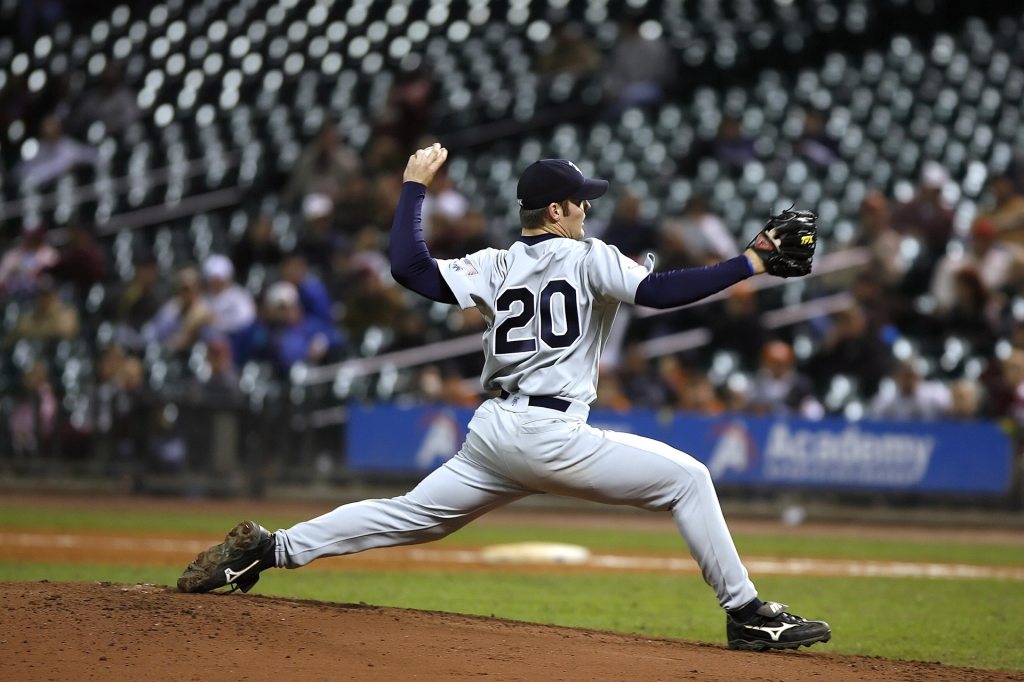
Batters rarely actually advance to first base, and this is due mostly to the skill of major league pitchers. The duel between a pitcher and a batter is the focus of many baseball innings, and a successful pitcher can potentially end an inning in nine clean pitches if he’s really on fire.
More commonly, there is a game within a game, where the pitcher gives the batter pitches that are hard to hit cleanly, but still inside the strike zone. In this way, the batter is in a losing proposition: he either does nothing and likely takes a strike, or swings and misses to guarantee a strike. However, pitching perfectly is very difficult – a pitcher who throws too wide, too high, or too low gives the batter a “ball,” which does not count as a strike. Every batter has different strengths and weaknesses, so a pitch that one batter might struggle to hit would be easy pickings for another.
A batter is usually off the plate in one of two ways: three strikes and he’s out, and the batting team must field another batter, or four balls and he walks to first base automatically. Batters employ many techniques to hit as many pitches as they can, and to encourage the pitcher to throw pitches they can ignore to rack up balls.
Because a major league pitch is so fast, batters cannot react in the perfect way every time: they must commit to covering a certain “section” of the space above home plate, and pitches outside of that space are ignored.
Leagues
Baseball is most popular in the United States, where Major Leage Baseball (MLB) is the premiere league. There are also regional leagues for lower divisions, many of which have “farm teams” which exist not to compete strongly themselves but to create strong players who can move up to the major leagues. There are also many recreational leagues for adults and children.
Outside the U.S., baseball is popular in Japan and Cuba. The highest league in Japan is the Nippon Professional Baseball league, which dates back to 1934.
In Cuba, the system is much more stratified compared to either the U.S. or Japan: each province has teams that compete at various levels, and the most successful teams each season come together in the Cuban National Series. The National Series winners advance to play in Caribbean leagues and are often chosen to represent the country in international competition.
Trivia
In the early 20th century, how teams played baseball changed when the MLB threw out the “dead ball era” in favour of rules that encouraged higher scores and less underhanded play. In the dead ball era, one physical ball was used throughout a game and it would become scuffed and battered after a few innings. This made it harder for batters to hit far, and enabled the fielding team to control the infield much more – the pitcher could even tamper with the ball before throwing it. Players generally had to scrape for runs and rarely got on base. The new rules, which still affect baseball today, encourage higher scores and more consistent batting throughout a game.
Baseball has a huge list of jargon and slang words that have had a huge influence on American English. Some examples include:
– “Playing ball with” someone, meaning to do business with someone.
– “Batting a thousand,” meaning doing everything right. This phrase comes from a player’s theoretical maximum batting average of 1.000, which would mean getting a hit every single time he is at bat throughout a season.
– “Curveball,” meaning something unexpected.
– “Heavy hitter,” meaning someone powerful or commanding.
 Watchingallsports.com
Leave a comment